'%20stroke='%23FFFFFF'%20stroke-width='1.5'%3e%3ccircle%20id='Oval'%20cx='6.9820764'%20cy='5'%20r='4.25'/%3e%3cpath%20d='M0,18%20L0.394931775,15.5405897%20C0.784233891,13.1162378%202.87627751,11.3333333%205.33168755,11.3333333%20L8.60656395,11.3333333%20C11.0170079,11.3333333%2013.0843252,13.0531056%2013.5230481,15.4232875%20L14,18%20L14,18'%20id='Path-3'/%3e%3c/g%3e%3c/g%3e%3c/g%3e%3c/svg%3e)
'%20transform='translate(12.000000,%2011.000000)'%20stroke='%23FFFFFF'%3e%3cpath%20d='M14.9284847,2.86%20L16.4997013,17.3%20L0.777904514,17.3%20L2.30449259,2.86%20L14.9284847,2.86%20Z'%20id='Rectangle'%20stroke-width='1.4'/%3e%3cpath%20d='M5.04,2.88%20L5.04,0.25%20C5.04,0.111928813%205.15192881,-2.39230995e-18%205.29,0%20L11.99,0%20C12.1280712,4.09652979e-16%2012.24,0.111928813%2012.24,0.25%20L12.24,2.88%20L12.24,2.88'%20id='Path-2'%20stroke-width='1.25'/%3e%3c/g%3e%3c/g%3e%3c/g%3e%3c/svg%3e)








![/shop?suppliers[]=Doja](https://ik.imagekit.io/salve/wp-content/uploads/2023/02/17142721/DOJA-NEW.png?tr=f-webp)
![/shop?suppliers[]=Wizard%20Trees](https://ik.imagekit.io/salve/wp-content/uploads/2023/02/17142902/Wizard-Trees.png?tr=f-webp)
![/shop?suppliers[]=Super%20Dope](https://ik.imagekit.io/salve/wp-content/uploads/2023/02/17142844/super-dope.png?tr=f-webp)
![/shop?suppliers[]=Josh%20D](https://ik.imagekit.io/salve/wp-content/uploads/2023/02/17142823/JOSH-D-NEW.png?tr=f-webp)
![/shop?suppliers[]=UD+x+The+Flowery](https://ik.imagekit.io/salve/wp-content/uploads/2023/02/29062756/UD-Logo-for-Menu-Icon_BLK.png?tr=f-webp)
![/shop?suppliers[]=LitStick](https://ik.imagekit.io/salve/wp-content/uploads/2023/02/23071459/Litstick-drop-down-logo.png?tr=f-webp)
![/shop?suppliers[]=Maine+Trees](https://ik.imagekit.io/salve/wp-content/uploads/2023/02/15091555/Maine-Trees-website-drop-down.png?tr=f-webp)
![/shop?suppliers[]=Black+Box+Genetics](https://ik.imagekit.io/salve/wp-content/uploads/2023/02/17092953/BlackBoxGenetics_MenuTab_260x80.png?tr=f-webp)





This week’s wayback article is from May of 1983 and is called ‘CHOOSING A CANNABIS VARIETY; How to pick the pot that’s right for you.” It’s written from a ‘grow-it-yourself’ perspective but what’s more interesting to think about is how the concept of ‘exotic’ has shifted.

Forty years ago, cannabis wasn’t defined by brand names or breeder-named cuts — it was defined by geography. What you smoked was a reflection of where it came from: the altitude, the climate, the length of the growing season.
Afghan, Colombian, Thai — these weren’t just names, they were entire ecosystems. Growers didn’t talk about terpene profiles or genetic lineages the way we do now; they talked about latitude, harvest windows, and whether a plant could survive the conditions it was grown in. “Exotic” meant distant, rare, and deeply tied to place.
That’s what makes this piece so interesting to us – it captures a moment just before everything changed — before major indoor cultivation, before genetic libraries, before the explosion of hyper-branded ‘product’ we know and love. The obsession with quality hasn’t gone anywhere, but the terms we use to define what makes something rare or desirable have completely changed. What follows is a look back at how growers once chose their cannabis—and a reminder that while the tools have evolved, the pursuit hasn’t;
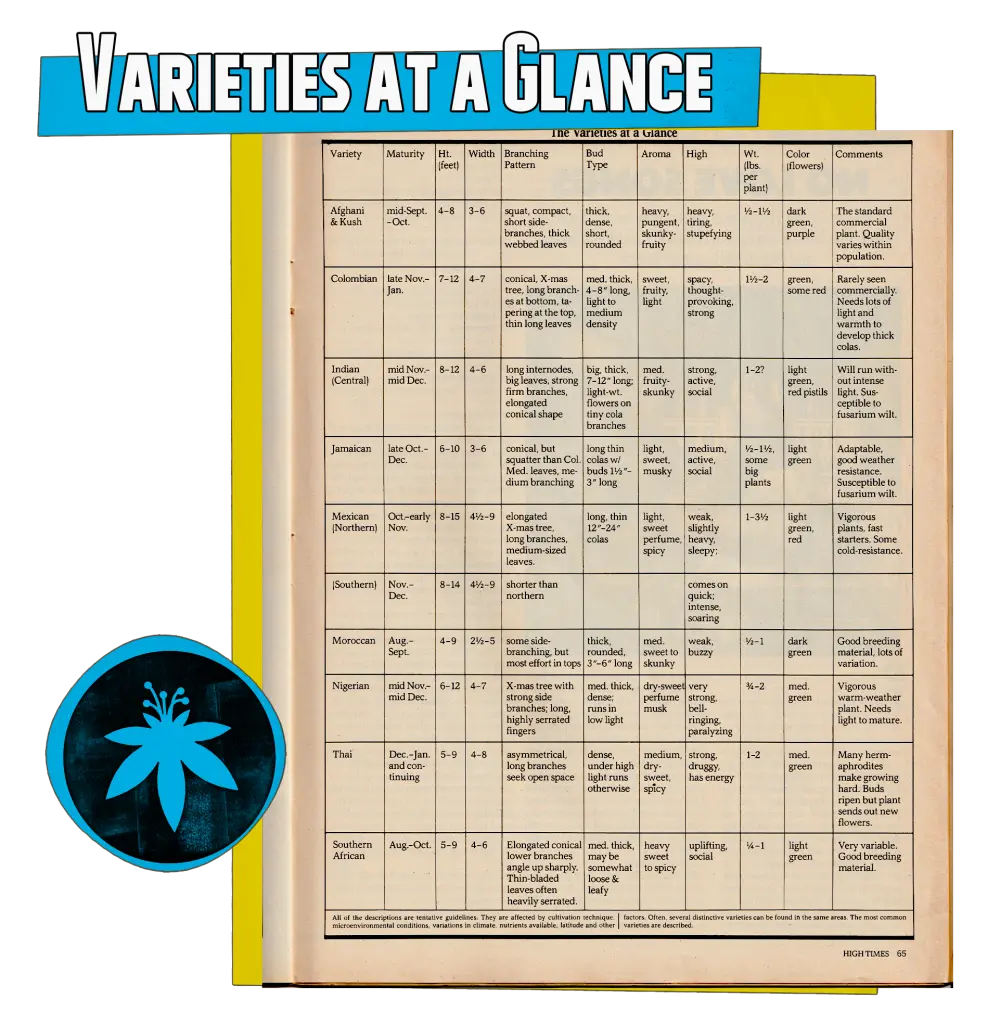

Seed catalogs are fascinating, really. For example, the tomato section of a typical catalog has pages and pages devoted to the different tomato varieties. Some are early bloomers, others are mold- or wilt-resistant. They have fruits ranging in size from a cherry to a grape-fruit, some for canning, others for juice. They even have yellow tomatoes and square tomatoes. Each variety was developed by researchers to meet a specific requirement.
When cannabis becomes legal, commercial seed houses will develop varieties to suit each individual garden and meet each gardener’s needs: “Let’s see, I’d like something that grows about six feet in six weeks, develops a giant cola, matures in sixty days, smells like cheap perfume, tastes like heady champagne and takes me to the moon.”
“R” has reported that there are already illicit seed co-ops functioning on a small scale. Last season, in certain western states, breeders commanded five dollars a seed for acclimated varieties. Even at that price, the seeds are worth it to the growers, who view the seed money as a minor investment, when the value of the harvest is considered. Rooted cuttings from proven outstanding plants sometimes sell for $5 a plant or more.
When it comes to choosing a variety, commercial growers are concerned with several factors, among them branching habits, drought resistance, ease in manicuring, color and uniform ripening. Primary is the ripening time. Most outdoor growers want plants that mature early, before the arrival of frost, thieves and law enforcement. Indoors, commercial growers want compact plants that ripen quickly and uniformly, so that light and space are used most efficiently.
Commercial growers are also interested in the plant’s yield. Some plants bud heavily and grow thick colas while others do not. A heavy-yielding plant may be worth twice the money of a light one. The type of the high does not seem to be an important marketing factor, but the yield, the aroma, the taste and the bud appearance are important factors in determining the price.
Homegrowers, however, have different priorities. The yield or growth time may not be as important as the type of high. Home gardens often contain several varieties of marijuana, some taking as long as six months to mature.
Seeds-people have concentrated their efforts on developing indica hybrids, which are desirable because of their early maturity (September to early October), and the heavy yields available on these compact plants. Some indica varieties are cold- and/or drought-resistant; and although the indicas exhibit a range of highs, I find most to be heavy and stupefying.
Commercial growers have tended to overlook potency and quality of high in their search for plants that mature early. They reason that they would rather have a poorer-quality sinsemilla harvest than no harvest at all. Very much like the tomatoes we discussed earlier, commercial varieties of cannabis ship well but are tasteless.
Turning to the sativa varieties, most mature too late (three to four months later than the indicas) for outdoor cultivation, and so are avoided by most commercial growers. Sativas also tend to grow tall with loose branching, so that their yield per square foot is less than indicas. However, the quality of high from sativa grown in the equatorial regions (Colombia, Congo, Nigeria, Kenya and Laos) is unsurpassed. It is unfortunate that only the homegrower (and his/her friends) can experience these highs; they are just not available commercially.
Sativa varieties grow all over the world. At the 5th parallel, in Jamaica and Mexico, there are some excellent sativa varieties which mature earlier than their equatorial cousins. Thailand is also at the 5th parallel, but its plants have a long growing season. Most of the commercial varieties available at the 30th parallel are indicas such as Kush, Afghani and Lebanese. But in the Southern Hemisphere at the 30th parallel, South African varieties will mature early and are often quite potent.
Thin leaves and pronounced serrations imply a Mexican—Equatorial African ancestry. Durban poison, Cape Town gold, Lesotho brown and Zuluweed, are vigorous short-to-medium-height plants with internodes of up to eight inches. They are also the earliest flowering and maturing plants ever introduced to the United States.
Like most cannabis varieties found at the 30th parallel, South African plants tend to vary within a specific population. This is an evolutionary technique of survival among species situated in environments that have a varied climate. African varieties are not usually imported into the United States, but find their market in Europe; there is usually a large number of Africans available in Amsterdam, for example.
Sativa varieties grown above the 30th parallel have been used for hemp, and are regarded as having no psychoactive qualities. But reports from the Midwest, where it grows in wild¹ stands, indicate that potency varies from terrible-headache weed to pot that delivers a fair buzz. Cultivators in areas where these stands are growing may wish to use those sativa varieties in their breeding program because they are well acclimated to the area, and survive with no human help. With a little patience, high potency and aroma can be bred into this hardy stock, which matures every year. By controlling all pollination and keeping detailed records, it’s easy to develop a simple breeding program, and within five or six generations you can develop and stabilize several characteristics.
Commercial breeders grow large numbers of plants from which a few outstanding specimens are chosen. Their descendants are again selected, and are often crossed with varieties that have other desirable traits. For instance, a hemp plant that matures very early might be crossed with a potent, later-maturing plant. The first generation will be pretty uniform. The second generation will sort out into early and late plants with varying potency. If only early-potent plants are selected for further breeding, this characteristic will stabilize after several generations
. Usually, commercial seeds-people try to stabilize many characteristics at once so that the plants are uniform.
A sophisticated breeding program can be developed indoors under controlled conditions. Many environmental factors can be easily controlled and the plants bred throughout the year. By turning the light cycle down to 15 hours a day (the number of hours of daylight available in late July), the researcher need only select early-maturing plants. Later-maturing plants may need longer periods of uninterrupted darkness, approximating late autumn or winter before they flower profusely.
Indoors, full-grown plants can be grown in one- to two-gallon containers. About two square feet of space is required per plant. Plants can be selected after a few weeks of growth, so that less space is required and the breeding program can be speeded up to three to five generations a year. Taking cuttings is the only way of preserving the exact genetic makeup of any plant. You may wish to keep an outstanding plant for garden clones or breeding. Over the years, American cultivators have developed tens of thousands of varieties. American sinsemilla is now the most potent in the world. Traditionally, marijuana cultivation extended only to the 30th parallel, However, American growers have expanded the growing area to Maine and Alaska.
Novice cultivators would do well to borrow seed from a successful local grower whose pot they especially like, that way, they know that the plants will mature in time, and be pleasant to smoke